


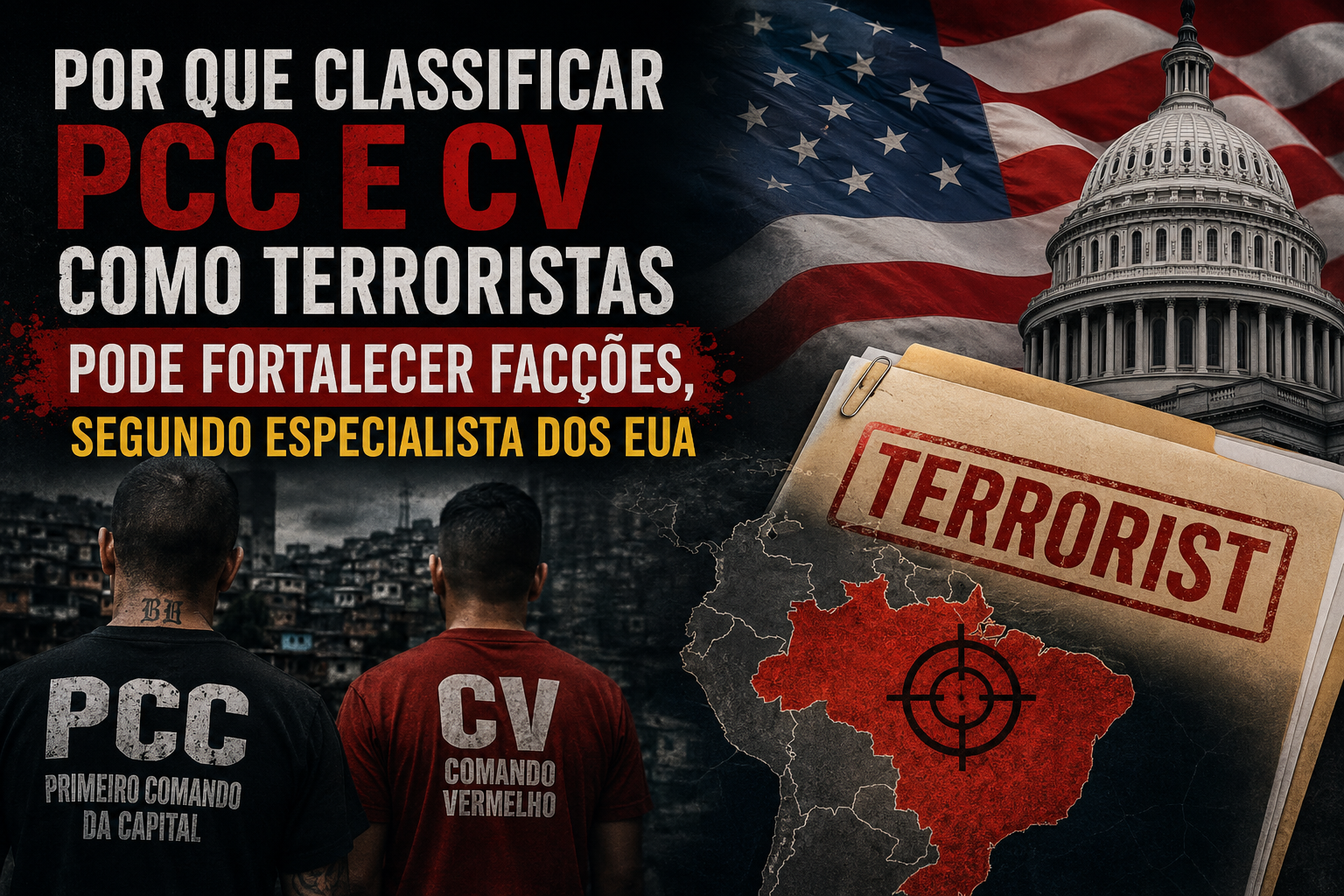
Why Labeling PCC and CV as Terrorist Organizations Could Strengthen Criminal Gangs, According to a U.S. Expert
Experts warn that labeling Brazil's PCC and CV as terrorist organizations could produce unintended consequences and strengthen criminal networks.
6/5/20263 min read
Why Labeling PCC and CV as Terrorist Organizations Could Strengthen Criminal Gangs, According to a U.S. Expert
The decision by the United States government to classify Brazil's First Capital Command (PCC) and Red Command (Comando Vermelho - CV) as terrorist organizations has sparked intense debate both in Brazil and abroad.
At first glance, the measure appears to be a tougher response to the growing power of organized crime. However, some security and international relations experts argue that the policy may have the opposite effect, potentially strengthening criminal organizations instead of weakening them.
Supporters claim that the designation provides stronger legal tools to disrupt financial networks and international operations. Critics, however, argue that it blurs the line between terrorism and organized crime, creating strategic and legal complications.
So why do some experts believe this classification could backfire?
What Changed?
By designating PCC and CV as Foreign Terrorist Organizations (FTOs), the United States gains access to a broader set of legal mechanisms, including:
Financial sanctions;
Asset freezes;
Immigration restrictions;
Expanded intelligence operations;
Criminal penalties for individuals who support these organizations.
Supporters argue that these measures can increase international pressure on the groups and make it more difficult for them to operate across borders.
The Main Argument: PCC and CV Are Not Traditional Terrorist Organizations
One of the central points in this debate is the definition of terrorism itself.
Historically, terrorist organizations pursue political, religious, ideological, or ethnic objectives. Violence is used as a tool to achieve broader political goals.
PCC and CV, on the other hand, are primarily profit-driven criminal organizations. Their main activities involve drug trafficking, weapons smuggling, money laundering, and other illicit businesses.
Because of this distinction, many analysts argue that treating these groups as terrorists may not accurately reflect their nature or objectives.
How Could the Classification Strengthen Criminal Organizations?
1. Increased Criminal Prestige
Criminal organizations thrive on reputation and fear.
Being labeled a terrorist organization by a global superpower can inadvertently elevate the status of a criminal group. In environments where gangs compete for influence, recruitment, and territorial control, international recognition as a major threat can become a symbol of power.
Rather than appearing as local criminal enterprises, PCC and CV may be perceived as globally significant actors.
2. Dilution of the Terrorism Concept
Another concern is that expanding the definition of terrorism could weaken its effectiveness.
If profit-oriented criminal organizations are classified alongside ideologically motivated terrorist groups, the distinction between organized crime and terrorism becomes less clear.
Some experts warn that an overly broad definition may reduce the precision needed to develop effective security policies.
3. Disruption of Existing Law Enforcement Cooperation
For decades, Brazilian and international law enforcement agencies have built cooperative frameworks to combat organized crime.
Some analysts fear that shifting PCC and CV into the terrorism category could move investigations away from traditional criminal enforcement channels and into national security structures.
This transition could complicate intelligence sharing, reduce operational flexibility, and create bureaucratic challenges between partner agencies.
4. Victimhood and Propaganda Narratives
Criminal organizations often use narratives to strengthen internal cohesion.
Being labeled as terrorist organizations by a foreign government may allow gang leaders to portray themselves as targets of political persecution or international interference.
While this does not transform them into political movements, it can serve as a useful propaganda tool for recruitment and loyalty-building.
What Supporters of the Classification Say
Those who defend the decision argue that PCC and CV have evolved far beyond traditional street gangs.
Today, these organizations operate transnational networks, control large segments of the drug trade, and move vast amounts of money through sophisticated laundering schemes.
Supporters believe the terrorist designation provides stronger tools to:
Track financial assets;
Freeze international accounts;
Target collaborators;
Improve international coordination;
Increase pressure on criminal leadership.
From this perspective, the scale and influence of these groups justify extraordinary legal measures.
Potential Diplomatic Concerns
The designation also raises geopolitical questions.
Some Brazilian officials and analysts worry that treating domestic criminal organizations as terrorist groups could shift the issue from law enforcement to national security.
This change may generate diplomatic tensions and spark debates about sovereignty, jurisdiction, and foreign involvement in Brazil's internal security matters.
However, legal experts emphasize that the classification alone does not authorize military intervention or direct foreign action inside Brazilian territory.
Brazil's Position
Historically, Brazilian authorities have preferred to combat PCC and CV through organized crime legislation rather than terrorism laws.
The prevailing view is that these groups are best addressed through:
Financial intelligence;
Asset seizure;
Anti-money laundering operations;
International police cooperation;
Drug trafficking enforcement.
According to this perspective, the greatest threat posed by these organizations lies in their economic power rather than ideological motivations.
Conclusion
The U.S. decision to classify PCC and CV as terrorist organizations represents a significant shift in the international approach to organized crime.
Supporters see the measure as a powerful new tool against criminal networks. Critics argue that it risks creating unintended consequences, including enhancing the prestige of these groups, weakening the conceptual distinction between terrorism and organized crime, and complicating existing law enforcement cooperation.
Ultimately, the debate highlights a broader challenge: modern criminal organizations have become so sophisticated that defeating them may require more than stronger labels. Long-term success will likely depend on disrupting their finances, dismantling their networks, and reducing their influence over local communities.
Contato
contato@horadepublicar.com.br
Endereço
Boa Vista - Roraima


© Hora de Publicar | 2025 | - Todos os direitos reservados