


11-Year-Old Brazilian Develops New Square Root Method Published in Scientific Journal
Discover the inspiring story of an 11-year-old Brazilian student who developed a new method for calculating square roots and had her work published in a prestigious mathematics journal.
7/7/20264 min read
A Discovery That Began in the Classroom
Groundbreaking scientific discoveries are often associated with cutting-edge laboratories, experienced researchers, and prestigious universities. However, remarkable stories occasionally remind us that innovation can emerge much earlier—even in elementary school.
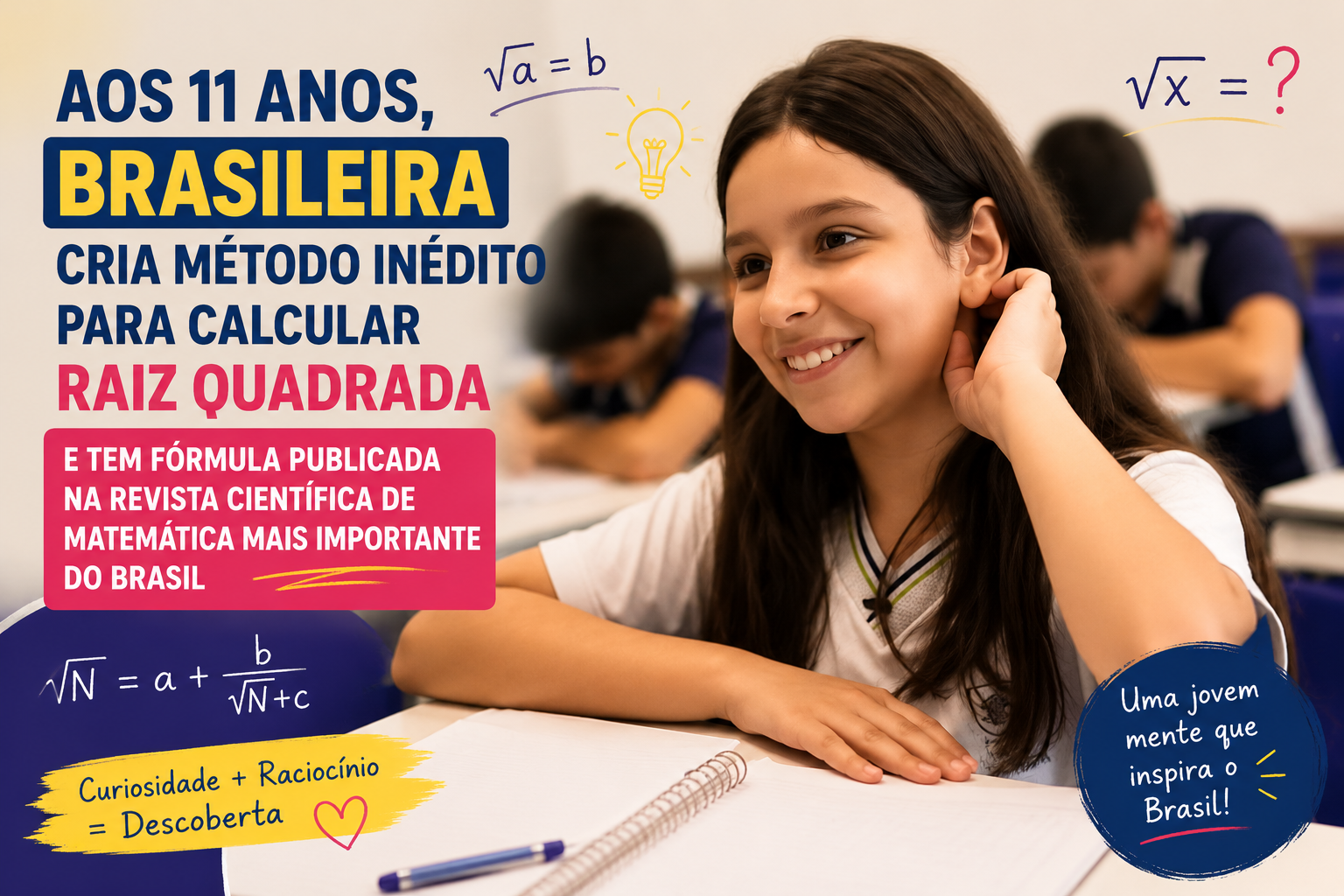
That is exactly what happened to Júlia Pimentel Ferreira, an 11-year-old Brazilian student who developed an alternative method for calculating square roots. Her work was later published in one of Brazil's most respected mathematics journals, drawing nationwide attention.
The story quickly became news because it challenges the widespread belief that scientific research belongs exclusively in universities. Instead, it demonstrates how curiosity, when encouraged by dedicated teachers and a supportive educational environment, can lead to genuine scientific contributions at a very young age.
More than just an interesting mathematics story, Júlia's achievement highlights the importance of nurturing critical thinking and creativity from the earliest stages of education.
What Happened?
According to published reports and the scientific paper itself, Júlia began wondering whether there might be different ways to calculate square roots while working on classroom mathematics exercises.
The method works by adding the square of a number to the number itself and its immediate successor, generating the next result in a continuous pattern.
Recognizing the significance of his student's discovery, her mathematics teacher provided the guidance needed to transform her observation into a formally structured mathematical model with broader academic relevance.
This distinction is important.
The paper was not published simply because its author was a child. Like any scientific work, it needed to present a clearly defined problem, explain the proposed method, provide mathematical reasoning, include practical examples, and discuss the scope and limitations of the approach.
This rigorous process is what transforms an interesting classroom idea into a legitimate scientific contribution.
Why Did This Story Attract So Much Attention?
Several factors explain why Júlia's story resonated so strongly with the public.
First, her age naturally captured people's attention. It is unusual for an elementary school student to become the author of a peer-reviewed scientific publication.
Second, the subject itself—square roots—is familiar to virtually every student. For generations, students have learned to calculate square roots using traditional methods or calculators.
When a young student develops an alternative approach, the story naturally sparks interest among teachers, researchers, parents, and the media.
Beyond the mathematical aspect, the story also carries a powerful symbolic message.
At a time when Brazil seeks to strengthen education in Science, Technology, Engineering, and Mathematics (STEM), examples like this demonstrate that scientific thinking can begin long before college.
How Does the New Method Work?
One of the first questions people asked after hearing Júlia's story was:
What exactly did she create?
The answer requires some clarification.
Several media outlets suggested that an 11-year-old girl had somehow "reinvented the square root." While this makes for an eye-catching headline, it is not an accurate description of what actually happened.
The mathematical concept of square roots has existed for thousands of years, and numerous algorithms have been developed throughout history.
Júlia's achievement lies elsewhere.
Rather than replacing the traditional definition of square roots, she developed an alternative strategy for simplifying specific calculations by identifying numerical patterns.
In other words, she proposed a different way of approaching a familiar mathematical problem.
This kind of innovation is common in mathematics, where multiple methods often exist for solving the same problem.
Why Are New Methods Important?
Many people assume mathematics is a finished science.
Nothing could be further from the truth.
Mathematicians continually develop new algorithms that make calculations faster, simpler, or easier to teach.
Multiplication provides a good example.
There are numerous multiplication algorithms used in different countries and educational systems, all leading to the same correct result.
The same principle applies to many other mathematical operations.
Developing a new method does not imply that previous methods were incorrect.
Instead, it demonstrates that there may be alternative ways of reaching the same solution.
This ability to discover new approaches is one of the defining characteristics of mathematical creativity.
What Makes This Discovery Remarkable?
Perhaps the most impressive aspect of Júlia's work is not the mathematical procedure itself, but the way it emerged.
Rather than memorizing formulas, she questioned existing methods and searched for patterns.
This mindset closely resembles the way scientific researchers work.
Every research project begins with curiosity.
Researchers observe phenomena, formulate hypotheses, test ideas, compare results, and refine their conclusions.
Even at the age of eleven, Júlia followed a simplified version of this scientific process.
That may ultimately be the most valuable aspect of her achievement.
The Teacher's Role in Turning an Idea into Science
Another key element of the story is the collaboration between student and teacher.
Creative ideas alone are rarely enough to produce scientific knowledge.
Research must be organized using appropriate methodology, technical language, and logical structure.
Júlia's teacher played an essential role in transforming her mathematical insight into a formal scientific paper.
This partnership illustrates how schools can become genuine environments for scientific discovery.
Teachers are not simply transmitters of knowledge.
They are mentors who help students transform curiosity into research.
What Does It Mean to Publish in a Scientific Journal?
To many people, publishing a scientific paper may seem like little more than an academic milestone.
In reality, it is one of the most important stages of scientific communication.
Before publication, articles are typically evaluated through peer review, a process in which independent experts examine the work for clarity, mathematical consistency, methodological rigor, and scientific relevance.
Only after this careful evaluation can a paper be accepted.
For an elementary school student to participate in this process is an extraordinary accomplishment.
At the same time, publication does not automatically mean that a discovery revolutionizes mathematics.
Scientific knowledge advances through discussion, replication, criticism, and continued investigation.
An Inspiration for Mathematics Education
Regardless of the future impact of the proposed method, Júlia's story sends a powerful message.
Students should not be viewed merely as passive recipients of knowledge.
When encouraged to ask questions, investigate ideas, and think creatively, they can become genuine contributors to science.
In a country working to strengthen mathematics education and scientific literacy, stories like this remind us that investing in curiosity may be one of the most effective ways to cultivate the next generation of researchers.
Contato
contato@horadepublicar.com.br
Endereço
Boa Vista - Roraima


© Hora de Publicar | 2025 | - Todos os direitos reservados